

Mantic builds a decision support system for wildfire risk management professionals, detailed wildfire behavior analyses covering metrics such as flame length, spread rate, and canopy fire potential across entire landscapes. Their simulations tell you where the danger is. Our challenge was to make them explain why.
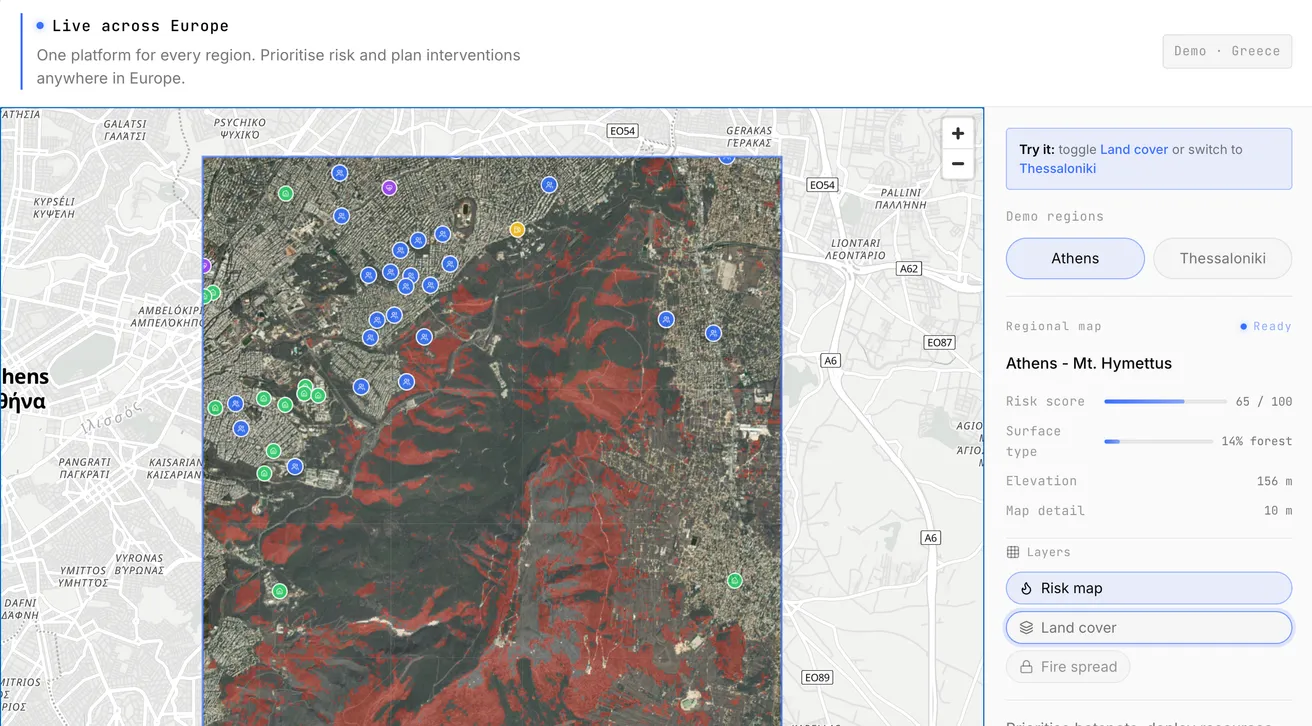
Mantic's wildfire risk maps produce hyper-local fire physics outputs: flame length, spread rate, crown fire potential, across complex landscapes. The data is accurate and actionable for specialists. But for fire management teams making operational decisions, the maps tell you where to look, not what it means. Interpreting a high-risk cluster requires a fire analyst who understands the simulation engine's underlying physics and what the scientific simulation results translate to in practice.
Mantic came to us to validate whether AI could automate that interpretation step, taking raw risk map data and producing structured, physics-grounded explanations that fire managers could act on directly, without needing a fire analyst in the room.
Partnering with Apex Lab has been an incredible experience. From initial idea exploration through to final project delivery, their team operated with a high degree of professionalism, quality, and transparency. The GenAI-based POC they delivered allows us to significantly fast-track our development process and test new features in the market much faster. Apex Lab will absolutely be our top choice for similar initiatives in the future.
Cluster Detection and Physics Calculation
The agent begins by processing the raw fire physics inputs. It identifies distinct high-risk clusters above a configurable area threshold, then calculates key statistics for each: flame length ranges, spread rates, canopy metrics, and the Van Wagner crown fire check, the physics test that determines whether surface fire transitions to the more dangerous crown fire behaviour.
Physics-Based Explanation Agent
For each cluster, the agent answers five specific questions: what drives the risk, what the crown fire potential is, how the terrain affects behaviour, what the weather implications are, and what conditions would escalate or reduce the threat. These aren't templated summaries, the agent reasons through the physics of each cluster individually using Claude Sonnet 4.6 via Amazon Bedrock, grounding every explanation in the actual data values.
The agent is built on the Strands SDK, which orchestrates the reasoning pipeline and calls a generic inference endpoint. This makes the underlying model plug-and-play: the PoC runs on Bedrock, but the architecture is designed for a clean switch to OpenAI or any other provider post-PoC.
REST API and Delivery
The full pipeline runs serverlessly: API Gateway → Lambda (Docker container) → S3 for input/output → Secrets Manager for credentials. Reports are returned as Markdown via REST API, with pre-signed S3 URLs for direct, secure access.
Reports can also be generated in Greek, practical for Mantic's Greek-market customers. All infrastructure is provisioned via Terraform.
Dual Evaluation Layer
Output quality is validated through two complementary mechanisms. DeepEval runs an LLM-as-judge evaluation against a curated golden sample of ideal explanations. A second layer of 88 mechanical checks validates factual accuracy independently without relying on an LLM judge for facts that can be verified deterministically.
DeepEval scored the agent's output at 0.9 against the golden sample, well above the 0.7 target Mantic set for the PoC. The 88 mechanical checks pass consistently across all test cases. Each full analysis run costs approximately $0.15–$0.22 in Bedrock inference. Mantic now has a working AI explanation layer for their wildfire risk management platform, one that turns complex wildfire behavior outputs into structured, physics-grounded insights that fire management professionals can act on. The next phase is integrating the agent into the core Mantic platform and extending the golden sample coverage to additional fire behaviour scenarios.
Tell us more about yourself and what you're got in mind.
Prefer email? hello@apexlab.io
Or even a quick call?
We don’t care about fancy CVs or long interview processes. Provide some basic information, let’s have a quick chat, and then show us what you love doing the most: write some code and create a product.
